
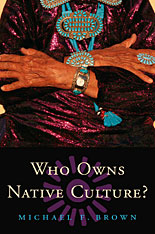
From the jacket copy. Who Owns Native Culture? documents the efforts of indigenous peoples to redefine heritage as a proprietary resource. Michael Brown takes readers into settings where native peoples defend what they consider their cultural property: a courtroom in Darwin, Australia, where an Aboriginal artist and a clan leader bring suit against a textile firm that infringes sacred art; archives and museums in the United States, where Indian tribes seek control over early photographs and sound recordings collected in their communities; and the Mexican state of Chiapas, site of a bioprospecting venture whose legitimacy is questioned by native-rights activists.
By focusing on the complexity of actual cases, Brown casts light on indigenous claims in diverse fields—religion, art, sacred places, and botanical knowledge. He finds both genuine injustice and, among advocates for native peoples, a troubling tendency to mimic the privatizing logic of major corporations.
The author proposes alternative strategies for defending the heritage of vulnerable native communities without blocking the open communication essential to the life of pluralist democracies. Who Owns Native Culture? is a lively, accessible introduction to questions of cultural ownership, group privacy, intellectual property, and the recovery of indigenous identities.
Author’s comment. WONC? is intended to be an accessible, sympathetic portrait of the efforts of indigenous peoples to reassert control over their intangible cultural productions and sacred sites, many of which have been appropriated and in some cases desecrated by more powerful outsiders. The book is not a study of the repatriation of physical objects such as human remains. Instead it looks at how the logic of repatriation is increasingly applied in such fields as religion, music, art and traditional knowledge.
What makes WONC? controversial in some quarters is that it does not automatically agree with the most radical of Indigenous claims—for instance, that elements of traditional culture long in circulation globally can somehow be “repatriated” to communities of origin. Instead, it considers (1) whether proposed strategies for ending cultural appropriation can be made to work in the real world; (2) whether the logic of repatriation as applied to physical objects readily applies to cultural productions that are easily digitized, broken up into fragments, and instantly distributed via electronic media; and (3) whether the potentially negative impact of certain forms of cultural protection outweighs their advantages. The book’s principal ambition is to nudge debate about cultural property beyond the sloganeering that so often characterizes it. And like most of my work, it pays homage to the Law of Unintended Consequences–that is, how ideas and policies that seem persuasive in theory often spawn undesirable effects and create new problems.
Who Owns Native Culture? has been widely adopted as assigned reading for university courses in law, Library Science, Museum Studies, Native American Studies, and anthropology. Excerpts of reviews can be found here.
For sophisticated, nuanced, and participatory research that shows how far the struggle against cultural appropriation has advanced in recent years, visit the website of a major project based in Canada, Intellectual Property Issues in Cultural Heritage (IPinCH).
ON AUDRA SIMPSON’S REVIEW OF WHO OWNS NATIVE CULTURE?
[Note: This response to a review of Who Owns Native Culture? was posted in a now retired website of mine in 2007. One may ask, Why revive it here? I do so because the issues raised by Simpson remain worthy of debate even years later.]
Eventually every writer has the unhappy experience of receiving a review that so distorts the intent and substance of one’s work that it appears to come from another planet. Fortunately such moments are rare. Most criticism is plausible, if ultimately unpersuasive to an author. In the best cases, criticism can be convincing and transformative. I doubt that I am alone in having occasionally contacted a reviewer to say something on the order of, “You were right about that point, and I wish I’d thought of it.”
Such is not my reaction to Audra Simpson’s essay, “On the logic of discernment,” published in the American Quarterly, vol 59 (2), 479-491. (Because the journal isn’t Open Access, I can’t provide a link to the full-text article here, although readers with login rights at a research library or campus network may be able to download it.) Simpson, a professor of Anthropology at Columbia, organizes the essay around reviews of my book Who Owns Native Culture? as well as Eva Marie Garroutte’s Real Indians: Identity and the Survival of Native America (Univ. of California P, 2003). I leave it to Professor Garroutte to defend her admirable book herself.
Let me start with some things that Simpson gets right. She correctly observes that both WONC? and Real Indians are offered as contributions to Native claims for justice and recognition. Her description of WONC?’s subject matter and scope is also reasonably accurate. She identifies me as a liberal—or as I would put it, someone committed to principles of liberal democracy while acknowledging their flaws—and she associates me with the work of the Canadian political philosopher Will Kymlicka. That is flattering company, even if I don’t agree with every element of Kymlicka’s particular vision of multicultural democracy.
As a result of my liberalism, Simpson says, I tacitly accept settler colonialism as it currently exists, decline to dwell on the historical injustices associated with it, and assume that Native citizens operate on an “even playing field, in which there is an intellectual commons that both indigenous and settler actors must share” (486).
Simpson is only partially accurate about this. WONC?’s two chapters on sacred sites generally assume that a wholesale return of all public lands, including national parks and forests, to indigenous communities is an unlikely scenario. In that sense I accept the status quo while insisting that federal and state governments can do more to accommodate legitimate Native religious uses of those lands. [2024 Note: In the intervening years I’ve come to support David Treuer’s proposal that Native nations should be granted at least a major administrative role in the management of some national parks. See his cover story in the Atlantic, 2021.]
But most of the book is about intangible cultural heritage, not sacred places. As a work based on multi-site interviews undertaken in the late 1990s and early 2000s, WONC? focuses on the present rather than the past, just as the people (Native and otherwise) interviewed for the book emphasized their present needs and aspirations. Simpson may be committed to a grand project of restitution, but that isn’t the subject of my book, and I see no reason why I must be held accountable to it. Perhaps the most important point is that even if some massive restitution of indigenous lands were imminent in North America and elsewhere, there is little reason to believe that this would resolve conflicts over intangible cultural property. That’s because intangible cultural heritage is not subject to the logic of national sovereignty. If you don’t believe me, take a minute to think about the Internet and the relatively limited ability of national governments to control it.
Simpson’s most egregious misrepresentation is that my book is “inflected with skepticism and disbelief” (489) and, again, that I “treat [the problem of cultural protection] with unrelenting skepticism regarding the sincerity or authenticity of these cultural forms” (487).
Even reviewers critical of WONC? have remarked that it treats Indigenous claims to ownership of cultural productions seriously and with unfailing respect. In many cases the book finds considerable merit in these claims and comments favorably on effective ways of resolving them. The book’s concluding chapter praises the many pragmatic Native intellectuals, local leaders, and cultural-resource managers who are working hard to resolve issues of cultural property—and often enjoying real success.
Genuine respect doesn’t mean accepting uncritically every slogan, accusation, or questionable assertion of fact. That is solidarity thinking, not critical analysis. Taking Native claims seriously means exploring their justification and implications and respectfully noting when they don’t withstand close scrutiny. WONC doesn’t declare that Native anxieties about cultural appropriation are bogus or trivial. Instead, it takes the claims at face value, tries to distinguish between those that are compelling and those that are less so (even to many Native people themselves), and describes efforts to improve the situation.
What WONC? is skeptical about is not indigenous rights but instead simplistic, slogan-based proposals to enforce new systems of cultural protection or ownership (“Total Heritage Protection”). My skepticism is based on the absence of evidence that they actually work in practice. There is, moreover, significant risk that they would strengthen the position of powerful global actors committed to privatizing the world’s intellectual commons. On balance, the book is less interested in making a romantic case for a global intellectual commons, which is what Simpson alleges, than it is in making a case against the development of multiple, dystopian anti-commonses, even when implemented in the name of Native rights.
This leads to a second major misrepresentation: that I am “statist.” I take this to imply that WONC advocates state-adjudicated solutions to disputes over cultural property. This is, in fact, exactly the opposite of what the book says. To the limited extent that the book is prescriptive, it cautions against state-mandated, formally regulated solutions to disputes over cultural property because history strongly suggests that the last thing Native people should cede to the state is increased control over Native art, music, ritual, and cultural productions in general, even in the name of “protection.” The Great White Father has made a mess of this in the past, and I see no reason to believe He’ll do better this time. I argue that the best hope for securing Native cultural productions lies in civil-society solutions and the articulation of a more robust theory of cultural privacy, coupled with reforms in the global system of intellectual property protection.
One curious inconsistency in the review is that while Simpson accuses me of impugning the sincerity of Native claims to ownership of local cultural productions, she earlier levels the charge of essentialism against Garroutte for trying to distinguish between original elements of Native American culture and such post-contact cultural pursuits as “ironwork or lacrosse, or beadwork” or interest in the music of Hank Williams Jr (485). Simpson’s comment on the skill with which Native people incorporate new cultural elements into their expressive world is consistent with WONC?’s argument that it is often difficult to distinguish between those elements of Native culture that arose in a particular community—therefore meriting protection under the terms of a system of “cultural copyright” yet to be invented—and those borrowed from neighboring Native groups or arising via sustained interaction with non-Native peoples.
I am left with a sense of bafflement that a scholar should offer such a tendentious misrepresentation of the tone and substance of a book under review. Simpson is free to disagree with my approach, of course, and others have done so in ways that have reshaped my thinking. But a line was crossed in her review, and it could not pass without challenge.
 UPRIVER
One response to ““Who Owns Native Culture?” (2003)”
[…] “Who Owns Native Culture?” (2003) […]
LikeLike