
Shamanism, The Timeless Religion (NY: Knopf)
By Manvir Singh
—Posted June 23, 2025, updated December 11, 2025
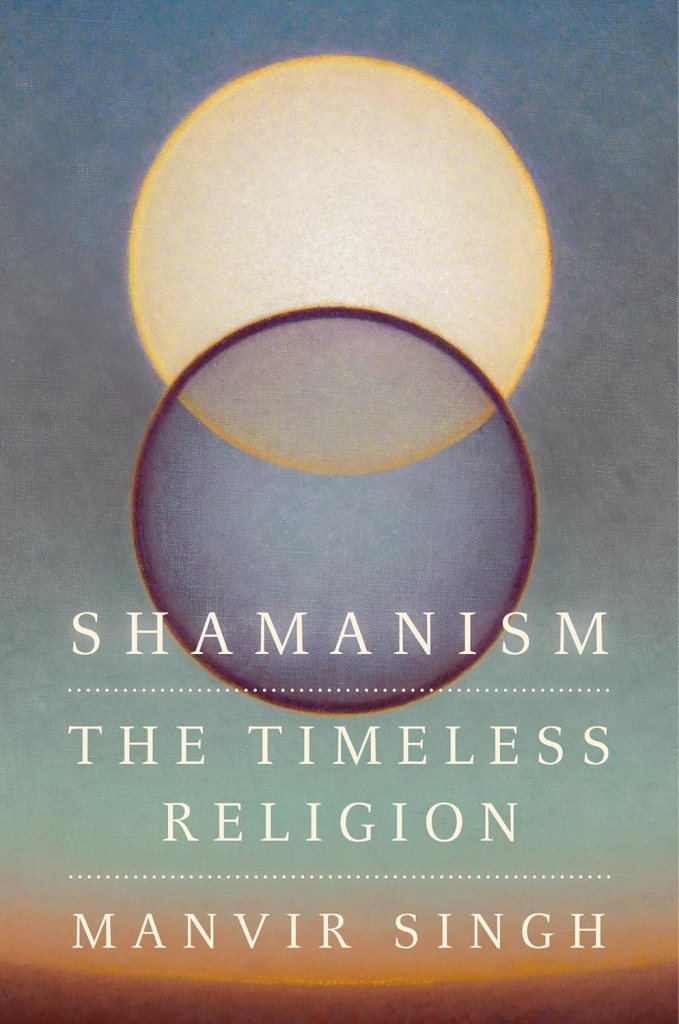
I had the pleasure of reading Manvir Singh’s new book, Shamanism, The Timeless Religion (NY: Knopf) in June. My review of it has finally appeared in the Open Access journal Asian Ethnology. Here I’ll simply offer a few observations about this provocative book, which should be celebrated both for the quality of its writing as well as the author’s achievement of publishing with a trade press, which is increasingly rare for academic anthropologists.
Singh, an anthropologist who teaches at UC-Davis, brings together his own global experiences (in Indonesia, India, France, Peru, Amazonia, and Nevada’s annual Burning Man event) as observer and occasional participant in traditional and neo-shamanic rituals. His goal is to identify shamanism’s common elements and explain why they remain so persistent—often in significantly modified forms—in the developed North as well as among Indigenous peoples. He does a good job of connecting his own experiences to the established literature in anthropology and religious studies.
Some scholars will question aspects of his approach, which among other things labels as “shamanism” a broad range of religious phenomena, from glossalia (speaking in tongues) to prophetism and spirit possession, commonly treated differently by anthropologists. The breadth of his approach is both a strength and a weakness. One weakness lies principally in the area of the political context of shamanism—that is, how shamans negotiate their spiritual power in a range of societies, including those that regard shamanic power as morally ambiguous because it can be used to kill as well as to heal.
In the interest of full disclosure, I should state that my own ethnographic work among the Peruvian Awajún, who are close linguistic cousins of the Shuar people studied by Michael Harner and others, confronts the violence that Awajún shamanic practice both promotes and attempts to heal. I wrote about this in part as a response to the pasteurized, idealized version of shamanism promoted by New Age practitioners in the US and Europe.

This agonistic version of shamanism isn’t universal by any means. Although Singh acknowledges the moral ambiguity of shamanic practice in some societies, he has different fish to fry. Above all, he effectively challenges the view that shamanism is associated only with simple societies at an early evolutionary stage. He makes his case with nimble, accessible prose and more than a dash of wit.
Sources on the micropolitics of Awajún shamanism and sorcery:
“Dark Side of the Shaman”
“Shamanism and its Discontents”
“El malestar del chamanismo”
Upriver: The Turbulent Life and Times of an Amazonian People (Harvard University Press, 2014)
 UPRIVER
You must be logged in to post a comment.