
Thoughts on Sahlins’s The New Science of the Enchanted Universe
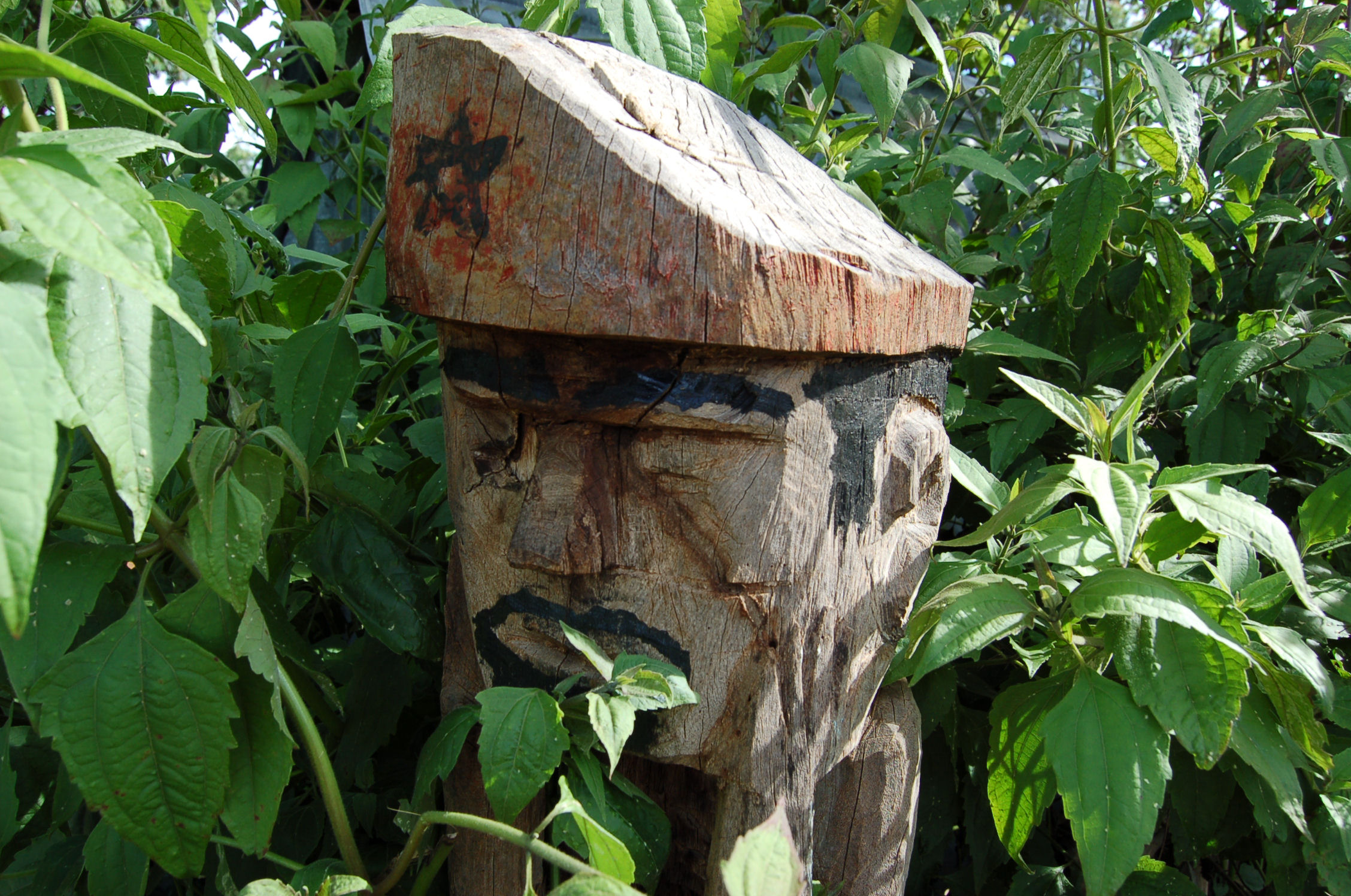
Image of a guardian spirit sculpture from a Jarai tomb in a cemetery near Kon Tum (Central Highlands, Vietnam). Credit: Renaud d’Avout d’Auerstaedt, 2008, Wikimedia Commons.
I admired Marshall Sahlins even before I took one of his University of Michigan courses in 1972, my first year of graduate school. The course drew on The Original Affluent Society and was one of his last at Michigan before he decamped to the University of Chicago. I was startled by Sahlins’s sudden abandonment of cultural materialism after exposure to the work of Claude Lévi-Strauss during a sabbatical in Paris. Above all, I was impressed by Sahlins’s clarity of presentation and his wit. Humor is a lamentably scarce commodity in anthropology, especially these days, but Sahlins was a master of the bon mot and groan-provoking pun. (Waiting for Foucault, Still, is arguably the funniest takedown of theoretical pretension ever penned by an anthropologist.)
Along with many others, I was saddened by his death at age 90. Throughout his long career he offered a distinctive, trenchant voice in an academic world that gravitates toward conformity. So it was with some excitement that I ordered a copy of The New Science of the Enchanted Universe: An Anthropology of Most of Humanity (Princeton University Press, 2022), published a year after his death.
Alas, what I found in this work was not the “new science” claimed by its title. To be fair, Sahlins was unable to finish this ambitious project. With the help of his son, the historian Peter Sahlins, and Frederick B. Henry, Jr., an independent scholar and foundation head, the manuscript was rendered suitable for publication. In his acknowledgments, Marshall Sahlins refers to the book as “a prolegomena to the new science of the enchanted universe.” What these insights could mean for anthropology, however, remains to be seen.
Rather than bushwhacking through the scores of ethnographic examples marshalled (pun intended) to support Sahlins’s argument, I’ll focus on his central thesis. Sahlins organizes the book around the distinction between “immanentist” worldviews and “transcendentalist” ones, a profound bifurcation of human ontological understanding. Immanentism sees divinity or spirit as permeating the entire world, whereas transcendentalists perceive divinity as divorced from everyday matters and residing in gods who intervene in human affairs only sporadically. Thinkers such as Karl Jaspers find the roots of transcendentalism in developments as early as the eighth century BCE, although others see it coming to fruition, at least in the West, during the late Middle Ages and Renaissance. As Sahlins memorably says of transcendentalism, “[T]he evacuation of the high gods from the earthly city has effectively put the culture under human control” (p. 5).
With divinity distanced from the mundane affairs of daily life, conceptual categories such as “economy,” “politics,” and “nature” arose and became regarded as spheres largely subject to human agency, albeit with occasional intrusions—sometimes welcome, sometimes, not—by the gods. Sahlins prefers to jettison the word “spirit” in favor of “metaperson” because the former is indelibly linked to the unreal, the imaginary. In other words, he implies, the entire enterprise of anthropology is so infused with transcendentalist assumptions, encoded in the very categories used to interpret human social life, that is difficult for us to understand the ontological framework of peoples still largely governed by immanentism. When anthropologists document these social worlds, it is with a condescending dismissal of the natives’ animist beliefs and practices.1
Although critical of many twentieth-century ethnographies that document animism, Sahlins excavates useful information from scores of them. Understandably, he is especially drawn to ethnographers associated with the recent “ontological turn,” including Philippe Descola and Eduardo Viveiros de Castro.
The big reveal of The New Science, after 175 pages of snippets from a century’s worth of ethnographies, is that Émile Durkheim’s understanding of religion—conventionally compressed to the tagline “Religion is society worshipping itself”—must be turned on its head. Rather than people modeling the spirit world after society, Sahlins says, “[H]umans did not imagine the gods, they only objectified, or more precisely, subjectivized, the extra-human forces by which they themselves lived and died. The forces were already there. They were not imagined” (pp. 174-175, italics in the original). He then goes on to declare that human social hierarchies reflect and arise from the inherent hierarchy of these universal forces, in relation to which “humans are lesser, dependent beings in an enchanted universe” (p. 175).
This makes compelling sense . . . until one thinks about it. Animists envision these powerful forces as human or at least human-like, which sounds awfully Durkheimian. After all, what is inherently human-like about wind, rain, stone, or maize? How convincing is it to hold that social hierarchies arose to match human subservience to the power of “metapersons”?
Sahlins is hardly the first to point out that even citizens of complex Western societies sometimes speak of inanimate phenomena as if they were metapersons, as in “The market thinks that interest rates will rise” or, as in a recent statement in The Guardian, “Life could have chosen left-handed DNA and right-handed proteins instead.”2 Immanentism and transcendentalism are scalar phenomena rather than pure states. Yet The New Science is inclined to speak of animism as a totalizing ontology, permeating every moment of life. This may have been true in the distant past, although I have my doubts, but given something approaching global cultural hybridity, isn’t it anachronistic to claim that the “most of humanity” of the book’s subtitle embraces this pure ontology?
My own ethnographic observations among the Awajún people of Peru’s Upper Amazon are generally consistent with the ontological observations of Philippe Descola and Anne-Christine Taylor among the closely related Achuar living across the border in Ecuador. The Awajún, however, have been in contact with the state longer and with greater intensity than have the Achuar. Many are literate and bilingual. According to some estimates, twenty-five percent embrace evangelical Protestantism to a greater or lesser extent, which implies some level of commitment to a transcendentalist view. Yet many of these same converts maintain a strong fear of sorcery. Others may turn to ayahuasca in search of visions and encounters with spirit-beings that ensure prosperity and protection from enemies. Acknowledging the animist elements of Awajún experience is necessary but not sufficient to understand the dynamics of their daily life in the twenty-first century.
I worry, too, that an exclusive focus on immanentist ontology by anthropologists leads some to drift perilously close to accepting the literal/empirical existence of metapersons. Sahlins was too smart to fall into this trap, but some recent work by others drifts in that direction without quite owning up to it. One suspects that this reflects pessimism about the ability of science to heal an increasingly poisoned planet and the hope that re-enchantment of the world will save us from our collective irresponsibility.
In sum, The New Science of the Enchanted Universe is a vigorously argued—one might even say spirited—account of animism, written with Sahlins’s accustomed flair and thoroughness. But as a model for a new, revitalized anthropology it raises more questions than it answers.
*************
Footnote 1. Perhaps I may be forgiven for noting that in an essay published more than 25 years ago I proposed that the term “magic” be banished from ethnography for precisely the reasons that Sahlins explores in The New Science. It is by no means clear that practitioners meaningfully separate “magic” from practical activities or technology even if anthropologists do. Magic is often, although not always, interwoven with activities that produce real-world effects.
Footnote 2. One of my favorite New Mexican bumper stickers says “I’ll believe that corporations are persons when Texas executes one.”
 UPRIVER
Leave a comment